
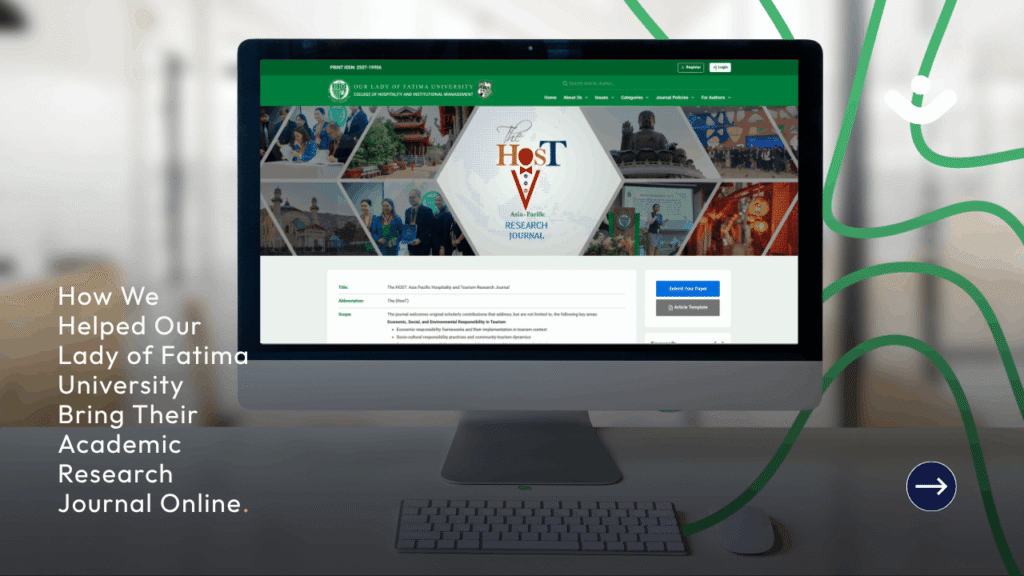
Most academic journals in the Philippines still live in binders. Printed, filed, and largely inaccessible unless you know exactly where to look. That’s a real problem when the research inside them is genuinely valuable.
Our Lady of Fatima University (OLFU) knew this. Their physical journal, The HosT: Asia Pacific Hospitality and Tourism Research Journal, had years of peer-reviewed research on sustainable tourism, responsible hospitality practices, and regional industry development. But without a proper online home, that work wasn’t reaching the researchers, students, and institutions that needed it most.
That’s when they partnered with CliqAlly. Together, we built thehostbyolfu.com, a fully functional online research journal platform that launched in November 2025. Here’s a look at what we built and why it matters for other academic institutions thinking about making the same move.
Why OLFU Needed More Than a Print Journal
Print ISSN numbers identify a journal in its physical form. OLFU’s journal already had one: 2507-19956. But to be indexed in academic databases, to be discoverable through Google Scholar and similar tools, and to be treated as a legitimate digital publication, a journal needs an Online ISSN too.
That was one of the first goals. By building a proper online journal platform, OLFU positioned The HosT to apply for and display its own Online ISSN, giving it equal standing alongside other peer-reviewed digital publications in the Asia-Pacific region.
A website alone wouldn’t have done it. The platform needed the right structure, the right metadata, and all the institutional components that give a journal credibility online. That’s what we focused on building.
What the Platform Does: A Feature-by-Feature Look
A Homepage That Communicates Credibility Immediately
First impressions matter, especially in academic publishing. When a researcher or student lands on the homepage, they need to immediately understand what the journal is, who publishes it, and whether it’s worth their time.
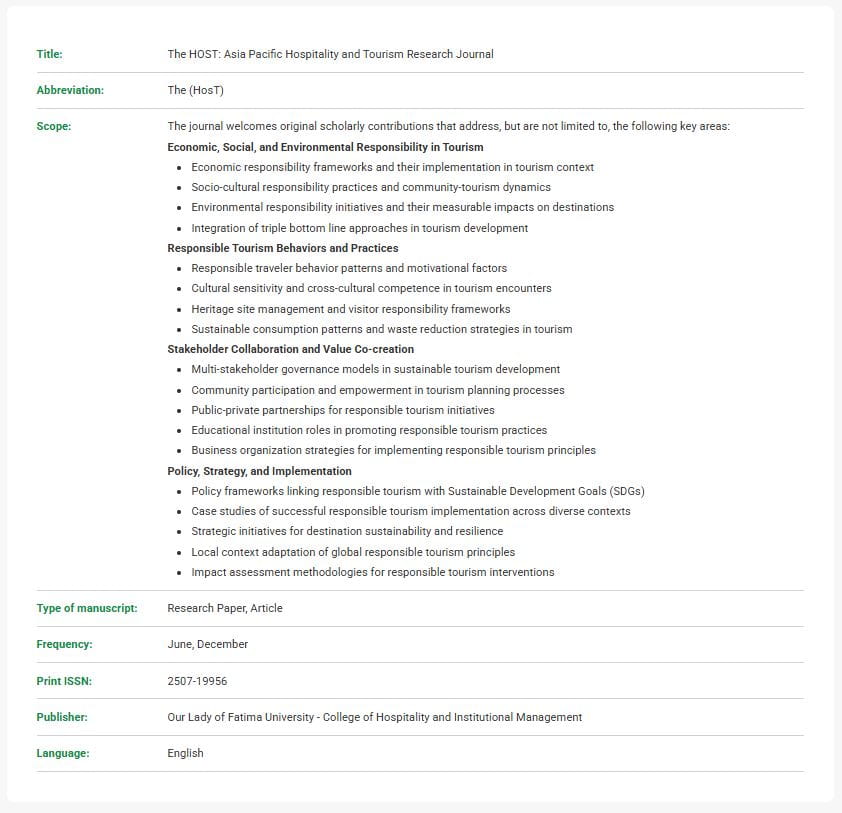
The homepage of The HosT covers all of it. It displays the journal’s full title, abbreviation (The HosT), scope, type of accepted manuscripts (research papers and articles), publication frequency (June and December), Print ISSN, and publisher details. The publisher is OLFU’s College of Hospitality and Institutional Management, and that context matters to anyone evaluating the journal’s credibility.
This isn’t decoration. Every detail on that homepage serves a purpose: communicating that this is a serious, structured, peer-reviewed publication with clear standards.
Current Issue and Accessible Research Papers
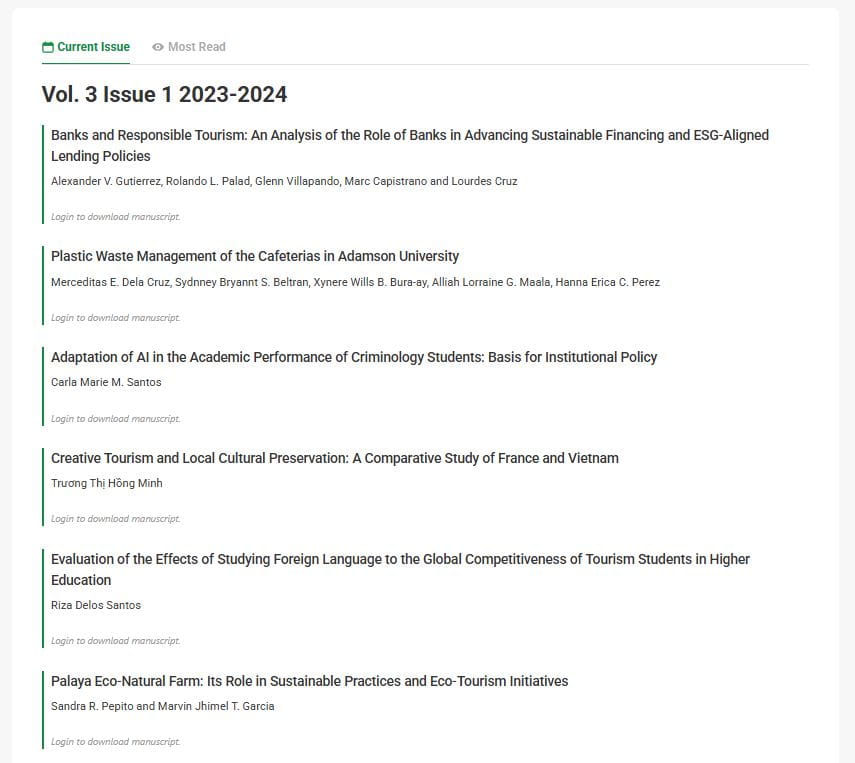
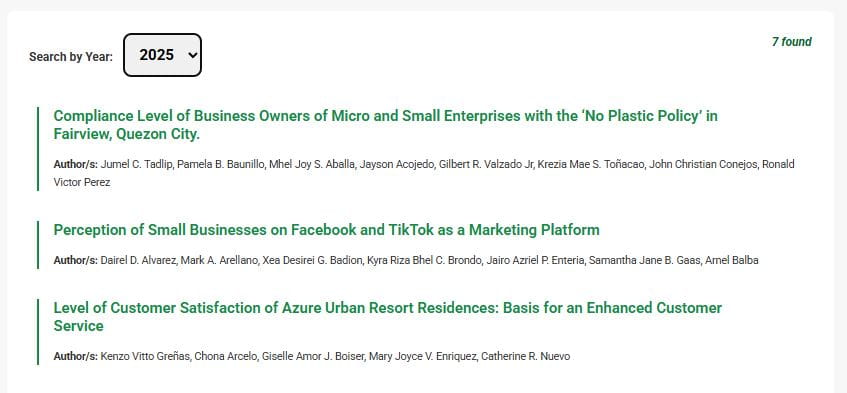
Researchers need to know what’s been published recently. The Current Issue section shows exactly that, presenting the latest volume with each paper listed by title, author, and abstract.
The current issue features work like a study on banks and responsible tourism financing, examining how ESG-aligned lending policies can support sustainable development in the hospitality industry. That’s the kind of practical, policy-relevant research that deserves a wider audience, and the platform makes sure it gets one.
Controlled PDF Downloads for Verified Users
Not every research platform can balance open access with institutional access controls. The HosT does. PDFs of each journal paper are available for download, but access is gated to two groups: enrolled students of OLFU, and external researchers who have gone through a formal access request process.
This protects the intellectual property of the researchers and the institution while still making the work available to those with legitimate academic interest. It’s a model that works, and it’s one we built into the platform from the ground up.
Most Read Research Articles
Visibility drives impact. When a researcher sees that a particular paper is being read frequently, it signals relevance. The Most Read section surfaces those papers automatically, helping visitors find the work that’s generating the most attention within the community.
It’s a small feature that makes a meaningful difference in how researchers navigate the journal.
A Transparent Editorial Team Page
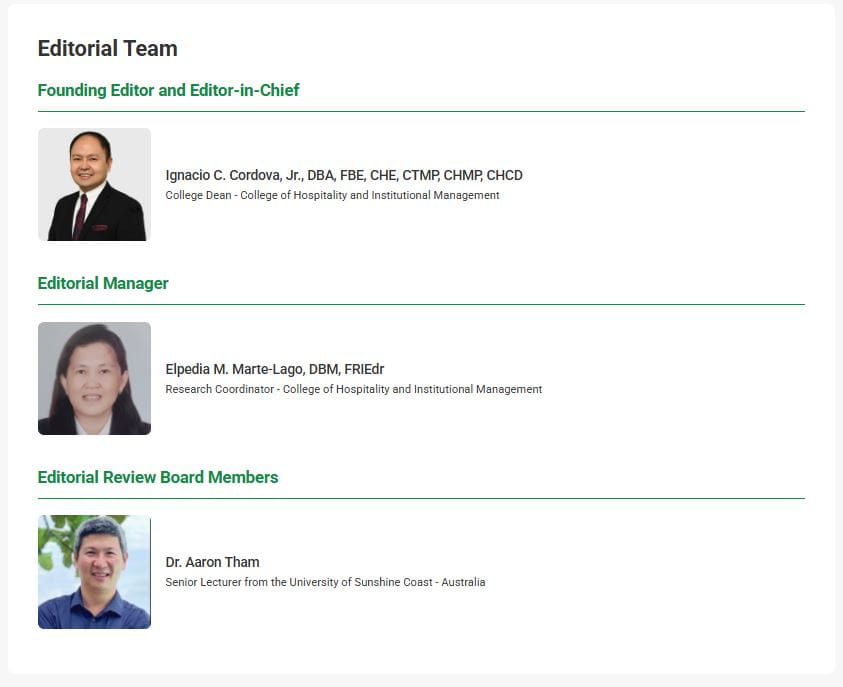
Academic credibility depends on the people behind the journal. The Editorial Team page introduces the scholars and professionals who review, curate, and approve submissions for The HosT. Researchers want to know who’s evaluating their work. Readers want to know who’s vouching for the quality of what they’re reading.
Putting that information front and center isn’t just good design. It’s good science communication.
A Full Archive of Past Research
The Archives section organizes all past issues of The HosT chronologically, making it easy for researchers to trace how topics have evolved over time or find specific studies from earlier volumes.
For a journal that’s been running in print for years, this was a critical part of the project. Digitizing and organizing that back catalogue gives those papers a second life, making them searchable and accessible for the first time.
Individual Research Paper Pages with Citation Support
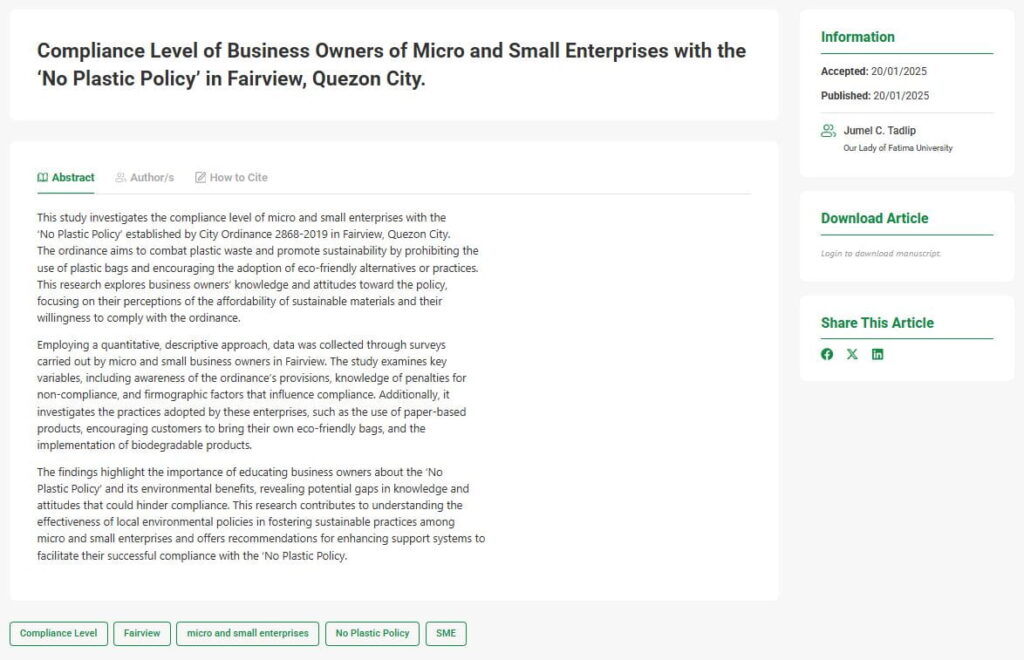
Every research paper on The HosT gets its own dedicated detail page, and those pages do more than just display text. Take this study on business compliance with the No Plastic Policy in Fairview, Quezon City as an example. The page shows the full research title, the complete abstract, and the author names clearly attributed. But the feature that makes it genuinely useful for the academic community is the “How to Cite” section.
Proper citation is how academic work gets credit. If a researcher wants to reference a paper from The HosT in their own study, the platform gives them the correctly formatted citation, ready to copy. They don’t have to manually piece together the journal name, volume, issue, authors, and year. It’s all there, formatted and accurate.
That’s not a minor convenience. In academic writing, citation errors are a real problem, and anything that reduces them makes the journal more reliable as a source. It also makes The HosT more attractive to researchers who want to reference the work, which in turn raises the journal’s visibility and citation count over time.
Clear Submission Guidelines and a Downloadable Article Template
Getting more researchers to submit to The HosT means making the submission process as clear as possible. The platform includes a dedicated Submission Guidelines page that walks authors through exactly what the journal accepts, how to format their work, and what to expect during the review process.
Better yet, the platform offers a downloadable article template. Researchers don’t have to guess at formatting requirements. They can download the template, write to the right specifications, and submit with confidence. That removes friction and signals that the journal values authors’ time.
Search by Keywords and Browse by Category
The HosT includes a keyword search function so researchers can find papers on specific topics quickly. It also organizes content into four clear categories: Economic, Social and Environmental Responsibility in Tourism; Responsible Tourism Behaviours and Practices; Stakeholder Collaboration and Value Co-Creation; and Policy, Strategy and Implementation.
Whether you’re looking for something specific or just exploring what’s been published, the platform gives you more than one way to find it.
Journal Policies That Build Trust
The platform includes a full section on journal policies, covering publication ethics, the publication process, the retraction policy, open access and copyright terms, and plagiarism screening procedures.
These aren’t afterthoughts. They’re the backbone of a journal’s credibility, and they needed to be clearly presented and easy to find. Every policy page on The HosT is structured to be readable and comprehensive, giving both authors and readers the transparency they expect from a serious academic publication.
A Detailed Peer Review Process Page
The peer review process is what separates a credible academic journal from a content aggregator. The dedicated Peer Review Process page explains exactly how submitted manuscripts are evaluated, what criteria reviewers use, and what authors can expect at each stage.
This kind of transparency builds confidence on both sides. Authors know what they’re getting into. Readers know the published work has been rigorously vetted.
Built on WordPress, Elementor Pro, and ACF Pro
Technology choices matter. We built The HosT on WordPress, which gives OLFU full ownership of their platform and the flexibility to manage and update content without relying on a developer for every small change. That’s not a small thing for a university team that publishes twice a year and needs to post new papers, update editorial team profiles, and manage access requests on their own schedule.
For the design layer, we used Elementor Pro. It gave us precise control over the layout and visual structure of every page while keeping the backend manageable for the OLFU team. Combined with Advanced Custom Fields (ACF) Pro, we were able to build custom data structures for journal metadata, research paper entries, author profiles, and issue archives, all cleanly organized and easy to update.
The design itself is minimal and clean by intent. Academic audiences don’t need visual noise. They need to find information quickly and trust that the platform they’re reading is professional. Every layout decision prioritized clarity: generous whitespace, a clear typographic hierarchy, and a navigation structure that makes sense the first time you use it. It looks the way a serious research journal should look. Straightforward, credible, and easy on the eyes.
This stack is also practical for institutions with limited in-house technical resources. WordPress is widely understood. Elementor Pro is visual and intuitive. And because we built the content architecture with ACF Pro, the OLFU team can add new research papers and update journal details without touching a line of code.
What This Means for Other Universities
The HosT platform is a good example of what happens when an institution takes its research seriously enough to invest in the right digital infrastructure. OLFU’s College of Hospitality and Institutional Management now has a journal that can compete for indexing, attract submissions from across the region, and give its students’ work the audience it deserves.
If your institution has a journal sitting in print, or a collection of research that isn’t reaching the people it should, the path forward is the same: a purpose-built platform that handles access control, metadata, peer review transparency, and discoverability all in one place.
That’s exactly what CliqAlly builds. We’ve done it for OLFU, and we can do it for your institution too.
The Research Deserves to Be Read
There’s a lot of valuable academic work that never gets the attention it should because the platform isn’t there to support it. A good research journal website isn’t complicated to describe: it makes the work discoverable, gives authors a reason to submit, gives readers a reason to come back, and gives the institution the credibility it’s earned.
That’s what we built for OLFU. If you’re a university, college, or research institution looking to bring your academic publications online, we’d like to hear from you.
Ready to give your research journal the platform it deserves? Contact CliqAlly to start your project and see what a purpose-built academic web platform can do for your institution.